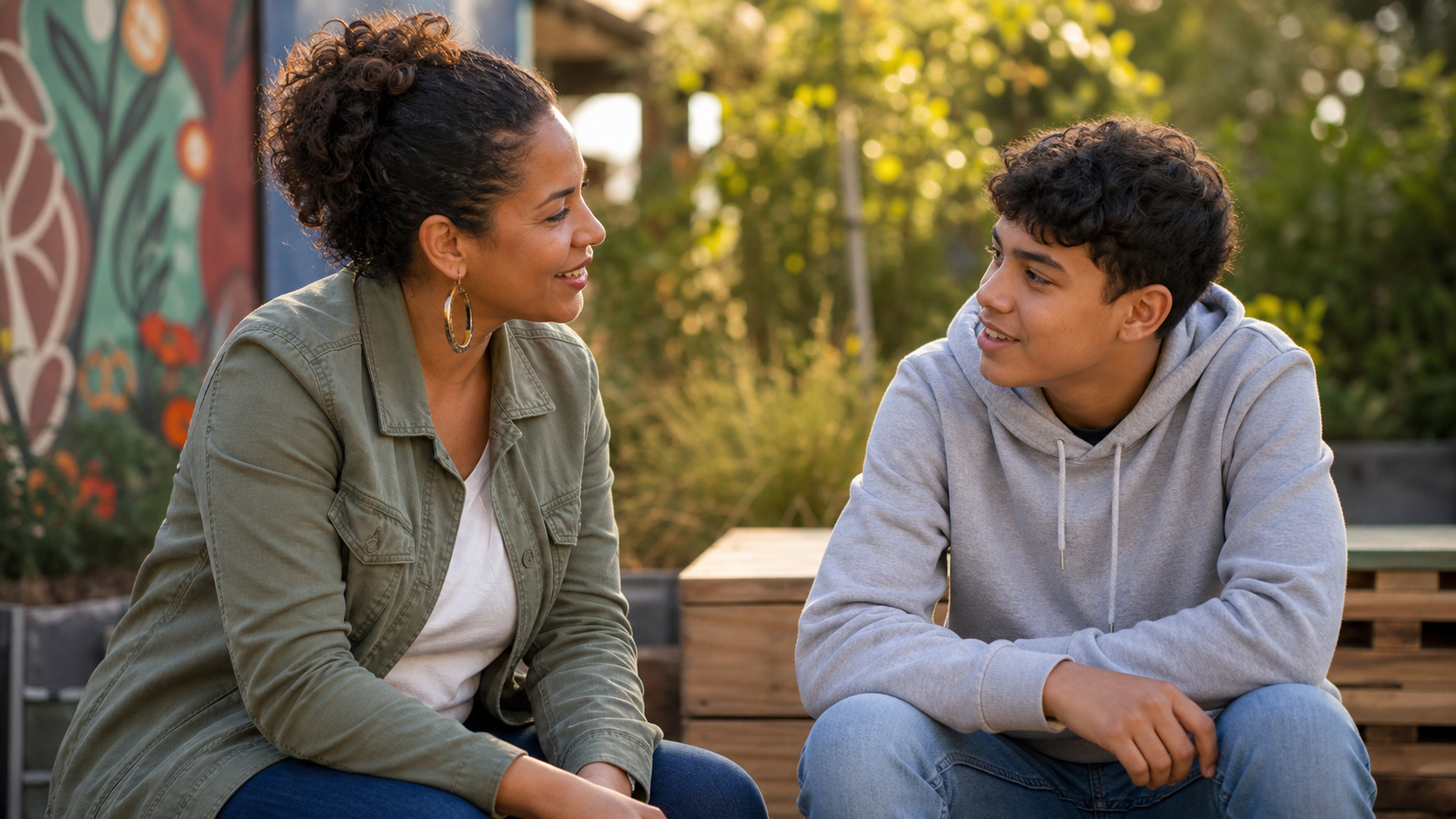
When a young person is struggling, conversations can quickly become focused on what is not working.
Why are they refusing school?
Why are they withdrawing?
Why are they becoming angry?
Why are they not using the support available to them?
Why are they not engaging?
This article is for: families, carers, support coordinators, educators, youth workers, and organisations supporting children and young people experiencing disengagement, change, or complexity.
These questions usually come from genuine concern. Families, carers, teachers, caseworkers, support coordinators, and practitioners want to understand what is happening and help the young person move forward.
However, when the conversation stays focused only on behaviour, risk, or compliance, it can become narrow. The young person may begin to feel that every adult is discussing what they cannot do rather than trying to understand their experience.
A different question can change the direction of a conversation.
It can help people move from reacting to the immediate issue towards understanding the social conditions shaping the young person’s capacity to participate, adapt, learn, and flourish.
The Schultz Human Flourishing Model™ provides an evidence-informed, strengths-based way to do this. It explores eight interconnected elements of human flourishing:
- Modern Pressures
- Adaptation to Change
- Values
- Community
- Life-Long Learning
- The Individual/Self
- Culture
- Moral Thinking
These elements are not a list of problems to identify or a formula to apply. They provide a framework for asking better questions about a young person’s life.
Here are five questions that can help shift the conversation.
1. What pressures is this young person carrying right now?
When a young person appears disengaged, angry, withdrawn, or unmotivated, it is important to consider the pressures they may be managing.
This relates to the element of Modern Pressures.
Young people today are navigating a complex world. They may be managing school expectations, online conflict, social media comparison, family stress, financial uncertainty, housing instability, disability-related barriers, changing friendship groups, or concern about the future.
For some young people, there may also be frequent appointments, changing workers, care arrangements, assessments, meetings, and adults making decisions about their lives.
A young person may not have the words to explain these pressures. Instead, they may show us through avoidance, frustration, exhaustion, or withdrawal.
Rather than asking:
“Why are they being difficult?”
Try asking:
“What might be feeling difficult, demanding, or overwhelming for them at the moment?”
This does not mean excusing harmful behaviour or removing all expectations. It means beginning with a more accurate understanding of the young person’s experience.
A young person who is struggling to attend school, for example, may not simply need stronger consequences. They may need support with a pressure that has not yet been recognised: peer conflict, fear of failure, sensory overload, family disruption, or an expectation that feels impossible to meet.
2. What has changed, and how much adaptation has been required?
The second question relates to Adaptation to Change.
Change is part of life, but that does not mean it is easy.
A young person may be adapting to a new school, a move, family separation, a change in placement, the loss of a relationship, a new diagnosis, a shift in support arrangements, or the transition from childhood into adolescence and adulthood.
Even changes that adults see as positive can bring uncertainty.
A “fresh start” at a new school may also mean losing familiar teachers, routines, friends, and places. A new support worker may bring helpful skills but still require the young person to begin building trust again. Increased independence can be exciting while also feeling daunting.
When a young person’s behaviour changes, it is worth asking:
- What has changed recently?
- What familiar people, places, routines, or relationships have been lost?
- What expectations are now different?
- Has the young person had enough time, information, and support to adapt?
This question can help adults avoid seeing an understandable response to change as defiance or lack of motivation.
It also leads to practical action. A young person may benefit from clearer information, familiar routines, gradual introductions, fewer changes at once, or one consistent person who can provide continuity.
3. Who is this young person beyond the concern in front of us?
This question relates to The Individual/Self.
When a young person has a long history of difficulty, it is easy for their identity to become tied to the concerns around them.
They may become known as the young person who does not attend, who has incidents, who will not engage, who needs constant reminders, or who is difficult to support.
These descriptions may reflect real concerns. But they should never become the whole story.
Ask instead:
- What interests matter to this young person?
- What are they good at?
- When do they seem most comfortable or capable?
- What has helped them manage difficult experiences in the past?
- What do they want adults to understand about them?
- What do they hope for, even if they find it hard to say?
This question helps bring strengths, aspirations, and identity back into the conversation.
A young person may be struggling in one setting while showing real capability in another. They may be quiet at school but highly knowledgeable about technology, sport, music, animals, art, family responsibilities, or practical work.
Those strengths are not separate from planning. They can provide the pathway into participation, confidence, and learning.
4. Where might this young person have a meaningful opportunity to contribute?
This question draws on Community, Culture, and Life-Long Learning.
Community is not simply about attending an activity, being placed in a programme, or having other people nearby. Meaningful participation happens when a young person has a real opportunity to take part in something that connects with their interests, identity, culture, or developing capabilities.
Culture also matters. It shapes how a young person understands family, responsibility, communication, identity, success, and connection. It includes family culture, First Nations identity and connection, faith, language, disability identity, peer culture, and the cultures of schools, services, and communities.
Life-Long Learning reminds us that participation is learned gradually. Young people develop confidence by having opportunities to try something, make mistakes, practise skills, reflect, and try again.
Useful questions include:
- What communities, places, people, or interests already matter to this young person?
- Where do they feel respected or useful?
- What cultural connections should be understood and strengthened?
- What is one small, achievable next step rather than a large demand?
- What could the young person learn through real participation?
For one young person, a meaningful starting point may be sport, music, caring for animals, a cultural group, helping a family member, gaming, gardening, volunteering, practical work, or a local community activity.
The aim is not to make every young person participate in the same way. It is to create opportunities that have genuine relevance to them.
5. What response reflects our values and helps the young person learn from this situation?
The final question brings together Values and Moral Thinking.
Values are expressed through everyday actions. Young people notice whether adults listen, explain decisions, keep commitments, admit mistakes, treat them fairly, and remain respectful during difficult moments.
Moral thinking involves learning about responsibility, fairness, care, consequences, and the impact of one’s actions on other people.
A strengths-based approach does not avoid accountability. It asks how accountability can occur in a way that supports learning and maintains dignity.
After a conflict, incident, or difficult decision, adults can ask:
- What happened from the young person’s perspective?
- Who was affected?
- What responsibility does the young person need to take?
- What support do they need to understand the impact of their actions?
- Is there a way to repair harm?
- What would a fair, respectful, and proportionate response look like?
- What have the adults involved learned about the conditions that contributed to the situation?
This shifts the focus away from punishment alone and towards responsibility within relationships.
It also ensures that the adults around a young person are guided by the values they want the young person to experience: respect, fairness, honesty, care, and accountability.
Better questions create more useful pathways
These five questions will not remove the complexity of supporting a young person who is struggling.
They can, however, help families and professionals move beyond the immediate behaviour and develop a fuller understanding of what is happening.
The Human Flourishing Profile™ is the structured process I use to explore how the eight elements of the Schultz Human Flourishing Model™ are operating in a young person’s life. It brings together strengths, pressures, relationships, culture, learning, change, values, community participation, and moral thinking into one practical picture.
From there, I develop a Professional Written Report and Six-Month Flourishing Plan™ to support clearer, more coordinated next steps.
When a young person is struggling, the answer is not always another strategy, another consequence, or another service referral.
Sometimes the most important first step is to ask a better question.